
I’ve spent the last twenty years reading the writers the world had already buried. Russian literary critics. Continental philosophers. Feminist film theorists who wrote about cinema in 1975 and never quite got credit for predicting Instagram.
My professors were adamant: if you don’t know this, you’ll be a tourist in your own time.
My name is Christina Stoltz, and the writers the world buried saw all of this coming.
Every recruiter, every finance person, every business-school grad I encountered insisted on the opposite. That I was wasting my education on dead theory. Why are you reading Walter Benjamin when you could be reading the McKinsey Quarterly?
I read both, for what it’s worth.
Then 2008 hit. I was awarded a Fulbright. Most of my class was unemployed. There was, it turned out, something to the critical theory after all.
From there, I went out and built big things with what I’d read.
Directing anti-trafficking advocacy efforts in Russia. Leading gender-based violence intervention initiatives in Kyrgyzstan. Building community-led social justice campaigns in Uzbekistan. Consulting for the United Nations in Tajikistan. Founding a nervous system literacy institute in the U.S. Writing a proprietary pelvic health curriculum and manufacturing the equipment to deliver it, scaled across the U.S., Indonesia, and the UAE. And now: cognitive systems design and critical wellness theory.
All of it built from the same critical theory I’d devoured at eighteen, toward the same ends: to create community where there was none, to deconstruct narratives that had failed people, and to redesign systems that had never been built for the bodies inside them.
The writers the world buried turned out to be the operational manual for the work I’d spend the next twenty years doing.
Then the AI agent workshops started showing up in my inbox.
Build 100 of yourself in an hour. Scale your authority. Multiply your impact.
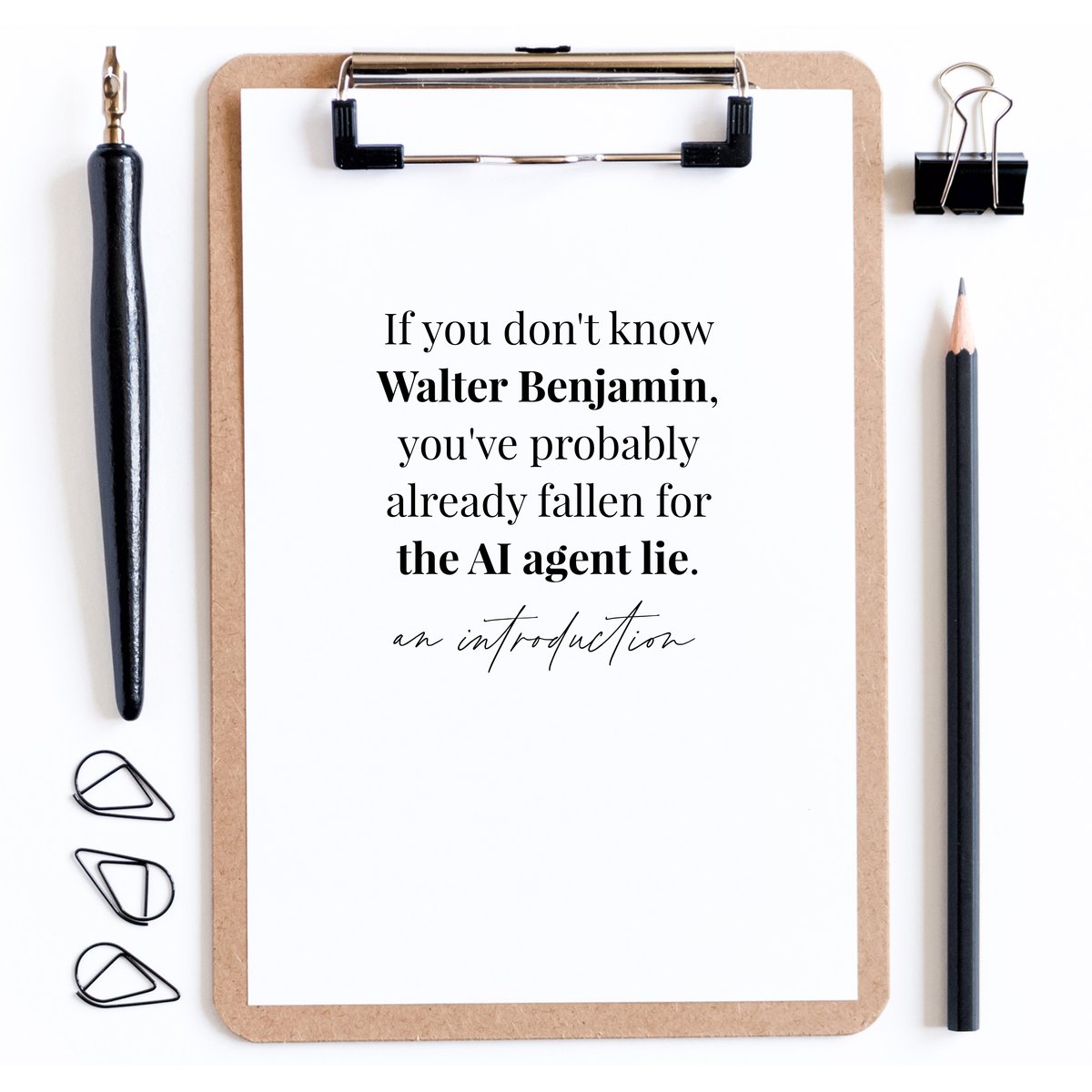
And it became clear to me: the people writing these emails have never read Walter Benjamin. They are recapitulating, ninety years late, the exact argument he made in 1936 about why mechanical reproduction destroys aura. Except now they are enacting it instead of reading about it, and they are charging $2,000 a workshop to teach you how to do it to yourself.
That is when I returned to the writers who had so sharply informed my early career in activism and academics. The cultural resonance of their work overwhelmed me. Not as inspiration, but as revelation. The only answer left was to start writing again. Myself.
The premise
The current advice is: don’t look back, that’s not where you’re going.
I think that’s the worst possible counsel for an era moving light years ahead.
You have to look back to go forward. Especially now.
Because what is happening right now — AI, automation, optimization, the entire industry of “build yourself but smaller and faster” — is not new. It is a pattern that thinkers we already have already named. They named it before there was a name for the thing we’d use to enact it.
- Adorno & Horkheimernamed the culture industry.
- Foucaultdiagnosed biopolitics.
- Mulveycaught the gaze automating.
- Bakhtinwarned us about the loss of dialogue.
- Derridatraced the supplement generating supplements of itself.
- Benjaminwatched aura die at the speed of the printing press, and predicted what would happen at the speed of anything else.
We just stopped reading them.
What I’m doing here
I’m resurrecting a canon. Not because it’s nostalgic. Because it works. And because someone has to call us back to thinking.
I write essays, some short, some long, that take the critical theory that defined my college and grad school years and put it in conversation with what is happening right now.
I learned to read the world at Dartmouth in the early 2000s, deep in the Baker-Berry stacks: as a research fellow under the late Lev Losev of the Russian department, chronicling the economy of gender in post-Soviet Russia; as a graduate student in geography and women’s studies, mining the geopolitics of nonprofit discourse for my master’s; and as a post-grad delivering the credit-led sociology curriculum I wrote for the women’s prison in Vermont. I didn’t know it then. I was being groomed for the work I do now.
Some of these essays are theory. Some are founder stories: what I learned from building two institutes — one for the body, one for the nervous system — and what I got wrong along the way. Because I’m putting this up front:
Wisdom is not learning from smart people. It’s learning from the screw-ups of smart people.
As a wise woman myself, I can tell you: I’ve made some pretty smart screw-ups. The lessons humbled me. They also handed me the framework I’m writing from. Not in spite of the screw-ups. Because of them.
Why this matters now
Everything is compounding.
The AI is compounding. The misinformation is compounding. The wellness theater is compounding. The optimization advice is compounding. The number of people teaching you how to scale yourself is compounding.
What is not compounding is your capacity to notice this is happening to you.
The critical theorists were right about this part. Adorno called it the culture industry. Berardi calls it semio-capitalism. Mark Fisher called it capitalist realism. The names matter less than the warning: the velocity of the present is designed to make the past unreadable. And once the past is unreadable, the future is whatever the loudest pitch tells you it is.
You could argue my master’s in comparative literature is more powerful right now than some executive MBAs, because it taught me how to think outside the register diagnosed through prompting and sublimation. That is the art the present is stripping out fastest.
I’d like to keep it that way.
Who I am
Cognitive systems designer. Critical wellness theorist. Author of the Human First Standard. Founder of two institutes: PLOOME (pelvic education) and REQ.1 (nervous system literacy, 501(c)(3) since 2010). I write two publications:
- Human FirstEssays on cognition, AI, and what to keep human as the machines scale.
- The Unfit IndustryEssays on what the wellness and medical industries got wrong about the body and the nervous system.
Same author. Two domains. One project: looking back at what we already knew, in order to see clearly what’s happening now.
What you’re going to get from me
Theory you can use. Founder stories that show their work. Pieces that take a single thinker and put them in conversation with one thing happening right now. The good wisdom, the better wisdom, and the wisdom that came from getting it wrong first.
I’m going to be sharp.
I’m going to be funny when something deserves it.
I’m going to be brutal when the situation requires it.
I’m going to assume you are intelligent.
That is the whole pitch.
Where to start
If you want the theory: subscribe to Human First.
If you want the wellness critique: subscribe to The Unfit Industry.
If you want both — and you probably do, because they are the same problem viewed from two angles — subscribe to both.
I’ll meet you there.
Christina
P.S. Get a library card. Stop scrolling.